Fresher Software Developer Resume: What a Reviewer Reads in Six Seconds
CareerCTO14 min read
A reviewer does not read your resume top to bottom. They scan a fixed path, skip most of the middle, and stop at the first working link. Build the top third for that scan, and put one project link where it will actually get clicked.
Nobody reads a fresher resume the way you wrote it. You spent three evenings getting the wording right, top to bottom, in order. A reviewer opens it, looks at four or five spots, and decides whether to keep reading. That mismatch is the whole problem this article is about.
This is written from the other side of the desk. Not "what should a resume contain" in the abstract, but what a person scanning fifty resumes in an hour actually does with your page, in what order, and what they skip without reading a word of it.
For a fresher, the stakes on this scan are higher than for anyone else applying. An experienced candidate's resume gets partly evaluated on company names and titles a reviewer already recognizes. Yours has none of that shorthand to lean on, which means the six seconds have to do all the work by themselves.
The six seconds are real, and they are not random
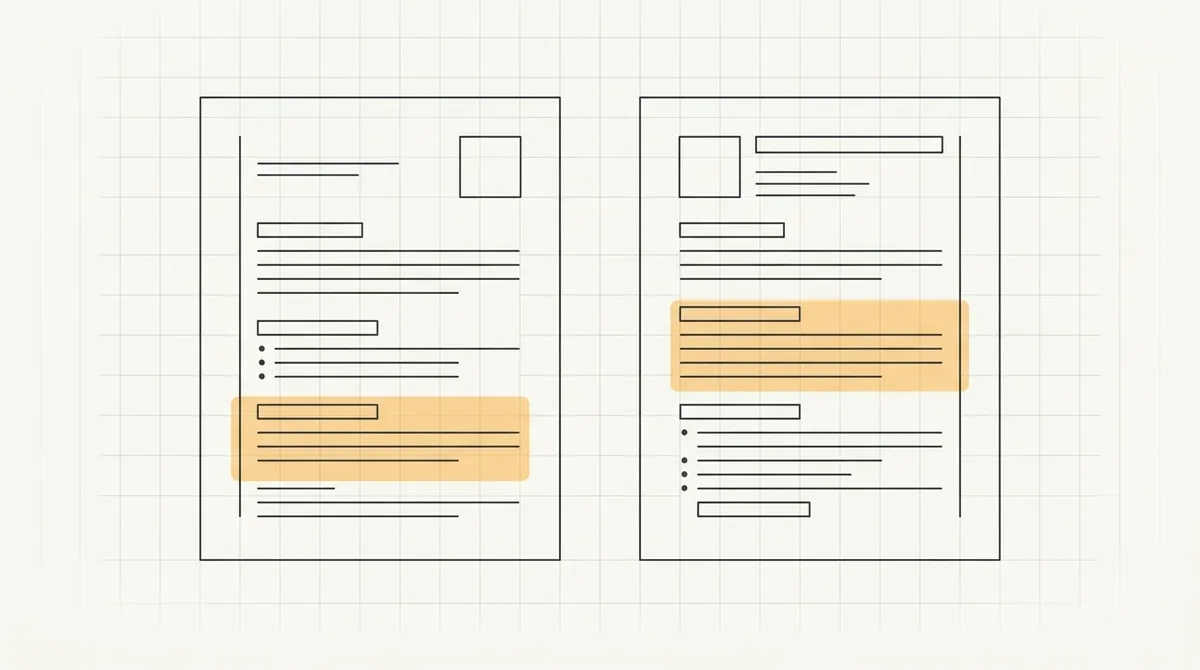
Eye-tracking on resumes shows the same pattern reviewers describe anecdotally: a scan, not a read. Name and title first, then a jump to the most recent role or the top project, then a sideways flick to check dates for gaps.
For a fresher, "most recent role" often does not exist. That gap changes where the eyes land next: usually straight to a projects section, if one exists near the top, or to a skills line if it does not. Where you place things decides what gets seen.
The six seconds decide one thing only: does this get a second look. It does not decide whether you get the job. It decides whether the reviewer spends the next ninety seconds on you or moves to the next resume in the pile.
The order eyes actually move down the page
Here is the path, roughly, for a resume with no work history to anchor on:
- Name and one-line title, top of the page.
- Contact block, just enough to confirm you are contactable and roughly local.
- The first bolded or capitalized project or experience heading.
- Any link in that heading - a name that opens something is worth a click.
- Education, mainly to check the degree and the graduation year against the dates elsewhere.
- Skills list, scanned rather than read, mostly to confirm nothing is missing that the job clearly needs.
Everything below that gets read only if steps one through four earned it. A second project, a certifications list, a hobbies line - these are read by the reviewers who were already going to shortlist you. They rarely change a decision on their own.
If you are also weighing campus placement against applying to companies directly, the resume matters more in one of those paths than the other - see campus placement vs off-campus hiring for how the process differs.
What gets skipped entirely
Some sections get almost no attention, no matter how well written:
- Objective statements. "Seeking a challenging role where I can utilize my skills" tells a reviewer nothing they cannot already guess. It is skipped by reflex.
- Long paragraph summaries. A block of prose at the top reads as effort, not information, in a six-second scan. Reviewers skip paragraphs and look for headings and bullets instead.
- A skills list with twenty entries. Past six or seven, a skills list stops being read as data and starts being read as decoration. The reviewer assumes it is padded, correctly or not.
- Coursework lists. Naming every subject you studied reads as filler unless one specific course maps directly to the job.
None of this means these sections are wrong to include. It means they will not be what earns you a shortlist. Spend your editing time on the four things that actually get read.
A hobbies line falls into the same bucket most of the time, with one exception: a hobby that is directly relevant, like running a small open-source project in your spare time, is really a project entry wearing the wrong heading. Move it up and describe it as such.
Why a working link beats a skills word-cloud
A skills list is a claim. A link to working code is evidence. Reviewers who have read hundreds of fresher resumes know the difference instantly, and it changes how they weigh the rest of the page.
Anyone can list "React, Node.js, PostgreSQL, Docker" whether or not they have built anything real with those tools. A reviewer cannot verify that line in six seconds, so it earns almost no trust on its own. It is a checklist, not proof.
A link that opens a deployed project, or a GitHub repository with commits spread over weeks rather than one weekend, is something a reviewer can act on in the same six seconds.
They do not need to read your code closely to get signal. A working demo, a clear README, and commit history that looks like real iteration say more than any adjective you could put next to "proficient in."
Put one project link in the top third of the page, not buried under three other headings. Make the link text the project name, not the raw URL, and make sure it opens without a login wall or a build step.
If you do not yet have anything worth linking, that is the actual gap to close before the resume - see how to get a job without experience for how to build something real without a job to point to first.
How to describe a project so it survives the scan
A project heading earns the click. The two lines under it decide whether the click was worth it. Most fresher resumes waste those two lines listing tools instead of showing what the project actually does.
Compare these two descriptions of the same project:
- "Built using React, Node.js, Express, MongoDB, and JWT authentication."
- "A shared expense tracker for roommates; splits bills automatically and sends a reminder when someone owes money for more than a week."
The first is a tag cloud. The second tells a reviewer what problem you solved and gives them a reason to click the link. Put the tool list in a short second line, after the sentence that explains what the thing does.
Where a project had real technical difficulty, name it in one clause rather than a full paragraph: "handles concurrent edits without overwriting changes" tells a backend-leaning reviewer more than "used WebSockets" does on its own. Specific beats impressive-sounding.
Common mistakes that cost freshers a shortlist
A few patterns show up often enough in fresher resumes that reviewers recognize them instantly, and each one quietly costs you attention:
- Every project looks the same size. A tutorial clone and a project you built and deployed alone get listed with the same three bullet points. Reviewers can tell the difference from the description alone; give the real one more space.
- Dates that do not add up. A graduation year that does not match a "3 years of experience" claim, or a project dated after you say you started your first job. Reviewers check dates specifically because gaps and inconsistencies are the fastest way to lose trust.
- A generic title mismatched to the role. Calling yourself "Software Engineer" on a resume aimed at a QA automation role reads as not having read the posting.
- No link at all. A fresher resume with a strong-sounding projects section but zero clickable links asks the reviewer to take everything on faith. Most will not.
- A link that does not open. A private repository, a demo that needs credentials nobody has, or a deployed link that has since expired. This is worse than no link, because it costs the reviewer a click that led nowhere.
- Typos in the first three lines. A reviewer who is already deciding in six seconds treats an early typo as a signal about attention to detail, fairly or not. Read the top third out loud before you send anything.
None of these take long to fix once you see them. They are also the reason a second pair of eyes - a mentor, a senior developer, even a careful peer - catches things you will not catch rereading your own resume for the tenth time.
Tailoring a resume to a specific job posting is not the same thing as stuffing it with keywords, even though the two get confused constantly. Tailoring means reordering and rewording what is already true about you to match what the posting is actually asking for.
If a posting emphasizes "REST API design" and your project description currently says "built the backend," rewrite it to name the actual pattern: "designed and built the REST API for the backend." You did not add a false claim. You made an existing true one visible to a reviewer scanning for that exact phrase, and to an ATS field matching against it.
This takes ten minutes per application, not a rewrite from scratch. Keep your base resume as a master copy, then adjust the top project's phrasing and the skills line order to match the two or three terms each posting leads with.

ATS parsing, honestly
Applicant tracking systems parse resumes into fields before a human ever opens them. This part is real. What is not real is most of the folklore around it.
Here is what actually breaks parsing, based on how these systems are built:
| Practice | Effect on parsing |
|---|---|
| Text inside a table or text box | Often skipped or read out of order |
| Skills or dates as an image | Not read at all |
| Standard section headings (Experience, Education, Skills) | Read reliably |
| Unusual headings ("My Journey", "What I Bring") | May not map to any field |
| A single-column layout in a standard format (.docx or text-based PDF) | Parses cleanly |
| A resume exported as a scanned image or a design-tool PDF with flattened text | May parse as garbage or nothing |
What does not help: repeating a keyword five times in white text, or pasting the entire job description into a skills section. Most modern systems either strip hidden text or flag the resume for a human to look at more skeptically. Keyword stuffing is a myth that persists because it is easy advice to give, not because it works.
The honest fix is simpler and less exciting: use the skill names the job posting actually uses, once, in a place that also reads naturally to a human
- your skills line or a project description. If the job says "REST APIs" and you built one, say "REST APIs." Do not also invent five synonyms hoping one of them matches.
A one-column, plain-format resume with your actual project names and skill terms, used once and in context, will parse cleanly on nearly every system in use. That is the whole trick.
What a fresher resume needs, in the order it should appear
Given the scan path above, here is a structure built for it rather than against it:
- Name and title - "Frontend Developer" or "Backend Developer (Java)", not "Software Engineer" if you have a clear lane. Specific beats generic for a first scan.
- Contact and one working link - email, phone, and a link to your best project or a portfolio page. City is optional; only include it if you are location-constrained.
- Projects, two or three, not five - each with what it does, what you built it with, and a link. One line on your specific contribution if it was a team project.
- Skills, six to eight items - grouped if it helps ("Languages:", "Tools:"), matched to the terms the job posting uses.
- Education - degree, institution, graduation year. A cohort completion belongs here too, named plainly.
- Anything else that earned its place - a relevant certification, an open-source contribution, a hackathon result. Optional, and short.
Two pages is rarely justified for a fresher resume. One page, tightly edited, reads faster and better under a six-second scan than two pages of the same information spread thinner.
Notice what is missing from this list: a work experience section. If you have an internship, it goes above projects, in the same evidence-first style - what you built or shipped, not a list of responsibilities you were assigned. If you do not have one yet, projects carry that weight instead, and there is nothing to apologize for in the gap.

What to leave off entirely
A few things actively cost you attention rather than earning it:
- A photo, unless the job posting or region specifically expects one. It adds nothing to a scan and can introduce bias a reviewer would rather avoid.
- References available on request. Reviewers assume this by default; the line only takes up space that a project link could use instead.
- Every certificate you have ever earned. Two or three relevant ones beat a wall of badges that dilute the ones that matter.
- A generic template you did not adapt. Reviewers who screen resumes all day recognize the popular free templates instantly, and a resume that looks identical to the last three they saw gets less benefit of the doubt, not more.
Where your online profile does the resume's job better
A resume is static and one-shot. A LinkedIn profile or a public developer profile can carry more evidence - endorsements, a longer project history, activity that shows you are still building - without needing to fit on one page.
Keep the two consistent. A reviewer who likes your resume enough to look you up and finds a thin or contradictory profile loses some of the trust the resume just built.
Same job titles, same dates, same project names - small mismatches read as carelessness even when they are just outdated copies. See building a LinkedIn profile as a developer for what to keep matched between the two.
This is also where a directory profile can do work a resume cannot: it stays current without you resending anything, and it can carry a verified cohort completion that a PDF cannot prove on its own. You can build a developer profile once and point every application at it.
A note on stack-specific resumes
The scan pattern above holds regardless of stack, but the skills line and project descriptions should speak the stack's own vocabulary. A resume written for .NET roles should name the actual framework versions and tools a .NET team uses, not a generic "backend development" line that could describe any stack.
If you are specifically targeting .NET roles as a fresher, the entry-level market there has its own patterns worth knowing before you tailor a resume to it - see .NET developer jobs for freshers for what those roles actually ask for.
The same logic applies to any stack. A reviewer hiring for a Django role scans for Django-shaped evidence, not a generic "worked with Python." Naming the actual framework, and the specific piece of it you used - migrations, middleware, a particular ORM pattern - reads as someone who has actually opened the documentation, not someone repeating a job posting back at them.
Two versions is not overkill
If you are applying to both frontend-heavy and backend-heavy roles, keep two short versions of your resume rather than one resume trying to cover both. The projects and skills line should shift to match the role, not stay generic to cover every possibility at once.
This takes an extra hour, not an extra week. Duplicate the file, swap the project order and the skills line, and keep both current as you build new things. A resume that speaks directly to the role in front of a reviewer will outperform a broader one every time, and neither version needs to pretend you are something you are not.
Where CareerCTO fits into this
A resume gets you past the first six seconds. What happens after that - does a company actually see it, does it land in front of someone who reviews freshers specifically - is a separate problem, and it is one a general application pile does not solve well.
CareerCTO lists reviewed openings rather than every posting a company has ever put online, and every profile can carry a verified cohort completion next to the same project links your resume already leans on.
The badge does not replace your resume's evidence. It does not vouch for your projects, skills, or experience, all of which stay self-reported - but it does confirm one fact a reviewer cannot otherwise check quickly: that you completed a specific cohort on a specific date.
You can browse verified developer profiles to see how others structure this, or go straight to reviewed job openings if you are ready to apply. If you are hiring rather than applying, you can post a role into the same reviewed pipeline.
None of this replaces the work of building something worth linking to. It just makes sure the resume you have built lands somewhere it will actually get read, in front of someone whose job is to look past a missing work history and toward the evidence you do have.
What to do next
Open your current resume and time yourself: cover it, then look at it for six seconds and cover it again. Write down what you remember. If it is not your name, one project, and one clear skill area, restructure the top third before you touch anything else on the page. Then send it to one honest person before you send it to a company.