Technical Interview Process Design: Fewer Rounds, Better Signal
CareerCTO14 min read
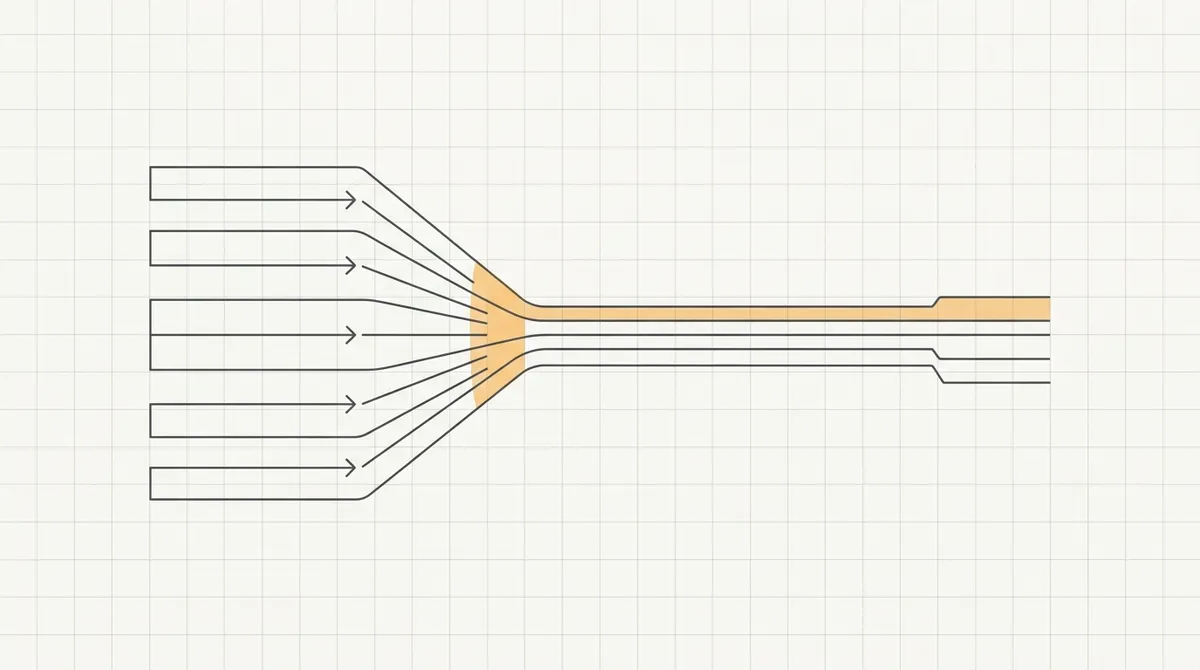
Every interview round should test something the others cannot. If two rounds test the same thing in different clothes, one of them is dead weight. Map each round to a distinct signal, delete the rounds that duplicate one you already have, and you will cut your loop from five or six rounds to three without losing anything you actually used.
A five-round loop feels thorough. It rarely is. Most hiring teams keep adding rounds the way a nervous cook keeps adding spices - not because the dish needs it, but because doing something feels better than doing nothing.
The result is a loop where round three and round five both quietly test "can this person write a for-loop under pressure," dressed up in different formats.
Nobody planned it that way. Each round was added one at a time, by a different person, to solve a different anxiety, and nobody ever asked what the whole loop was measuring.
This guide is about designing the loop backward from the decision you actually need to make, instead of forward from a list of things that feel safe to check. It ends with a worked three-round example you can adapt.
Why loops grow rounds instead of shrinking them
A round gets added when someone on the team has a bad hire story and wants a gate that would have caught it.
Nobody removes a round, because removing one feels like removing a safety net, even if that net was never actually catching anything in practice.
This is loss aversion applied to hiring process. The team overweights the cost of a false positive - hiring the wrong person - the same way it overweights any correlated failure.
It underweights the cost of the process itself: the good candidates who drop out of a six-week loop, and the interviewer hours burned on rounds that add no new information.
Nobody sits down to ask "does round four tell us anything round two did not." That single question, asked honestly, is most of what this guide is about.
If you are also rethinking the job posting that feeds this loop, see our job description template for developers.
A vague posting produces a candidate pool the interview loop then has to compensate for with extra rounds, which is a design flaw upstream of the loop itself.
Start from the decision, not the checklist
Before you touch round design, write down the actual decision you are making: should this specific person do this specific job, on this specific team, starting soon. Not "is this person a good engineer in the abstract."
That decision breaks into a small number of real questions. For a mid-level backend hire, it might be: can they write correct code without hand-holding, can they reason about a system they did not build.
Add two more: will they communicate clearly with the team, and do they want the parts of this job that are less glamorous than the parts they will talk about in the interview.
Four questions. Four signals. If your loop has six rounds, at least two of them are not mapped to one of these questions - they are mapped to comfort.
Write your own four questions before you read further, using the actual role you are hiring for right now, not a generic template. A borrowed list of questions produces a borrowed loop that tests someone else's job, not yours.
Some teams find they only have three real questions for a given role, and that is fine. A support-heavy role might not need a deep system design signal at all.
A role owning a critical service might instead need a fifth question about incident judgment that a generalist hire never needs.
The one-signal-per-round rule
The rule is simple to state and hard to hold to under pressure: every round in the loop must map to exactly one signal that no other round already covers.
If a round's best answer is "well, it also gives us a general feel," that round has no distinct job and should be cut or merged.
This does not mean each round tests only one narrow skill in isolation. A system design round naturally touches coding judgment, communication and trade-off reasoning at once.
The rule is about the primary signal you are scoring against, not about pretending a round is a single dial.
| Signal you want | Round type that actually produces it | Round type people wrongly use instead |
|---|---|---|
| Can write correct, working code | A focused coding exercise, ideally close to real work | A whiteboard algorithm puzzle with no reference material |
| Can reason about an existing system | Code reading or a bug-in-a-real-codebase exercise | A second, harder algorithm round |
| Communicates clearly under ambiguity | A live pairing or design discussion, scored on process | A panel round that mostly re-asks the resume |
| Wants this job, not just any job | A structured conversation about the actual day-to-day | A "culture fit" round with no rubric |
Use the table as a starting point, not a fixed answer. Your own four questions from the previous section should map to your own version of the left column before you decide what fills the middle one.
How duplicate signals sneak in
Duplication rarely looks identical on paper. It hides behind format differences. A take-home coding test and a live coding round can both be testing "can this person write correct code," just dressed differently.
The tell is in the debrief. If two interviewers, looking at two different rounds, keep writing the same sentence in their notes, you are paying twice for one signal.
Read the debrief notes from your last five loops before you assume your rounds are distinct. The notes will tell you faster than any org chart of who owns which round.
The other common duplicate is the pure "vibes" round: a casual chat that someone insists is measuring culture fit, but which in practice re-scores communication skill.
If you cannot write down what a culture-fit round is looking for that a technical discussion did not surface, cut it or rebuild it with an actual rubric.
A one-signal-per-round design also falls apart the moment two interviewers score the same round by different standards. Without a written rubric, "can they write correct code" quietly becomes "did I like working with them."
A rubric does not need to be elaborate. Three or four short, concrete criteria per round, written down before the loop runs, is enough.
The point is not precision - it is making sure the round measures the same thing on a Tuesday with one interviewer as it does on a Friday with another.
Write the rubric in language a candidate could read afterward without feeling ambushed. "Explained the trade-off between the two approaches without prompting" is a rubric line.
"Seemed sharp" is not a rubric line, and it is also the line most loops are quietly running on today.
Rubrics also make the signal audit from earlier in this guide possible in the first place. Without one, you cannot tell whether two rounds overlap, because nobody wrote down what either round was scoring.
Adjusting the loop by stack, without adding rounds
The three-round structure holds across stacks - the mistake is changing the number of rounds instead of the content of round one when you hire for a different technology.
A loop built for a generalist backend hire and reused unchanged for a specialist role usually tests the wrong things in round one.
If you are hiring specifically for .NET, for example, round one should look like real .NET work, not a language-agnostic algorithm exercise that happens to accept C#.
Our guide to hiring .NET developers in India covers where the specialist talent actually is and what a realistic .NET coding exercise should test.
The same logic applies to any specialist stack: keep the three signals, keep the three rounds, and change only what round one asks the candidate to do.
Adding a fourth round "just for the stack-specific stuff" is the same comfort spending this guide has been arguing against. Fold it into round one instead.

What each remaining round should hand off
A well-designed loop is a chain, not a set of independent gates. Each round should hand the next interviewer something specific to probe, not a blank slate.
This is the single biggest difference between a three-round loop that works and a three-round loop that just got shorter without getting better.
Concretely: the coding round should flag anything that looked shaky so the system design round can probe it directly, instead of starting from zero.
The system design round should in turn flag communication gaps so the final conversation can weigh how much that matters for this specific team.
Without handoff, a shorter loop just means less total information, not the same information in fewer rounds.
With handoff, three connected rounds can out-perform five disconnected ones, because each round builds on what the last one found instead of repeating it.
A worked example: the three-round loop
Here is a concrete loop for a mid-level full-stack hire, built signal-first. It assumes a real job description and a phone screen already filtered out obvious mismatches.
This loop starts once you are genuinely deciding between qualified people, not screening out obviously unqualified ones.
Round 1: Real-code exercise, 60 to 75 minutes. The candidate works through a small, realistic bug or feature in a sample codebase close to your actual stack, with reference materials allowed.
Signal: can they write correct code and read someone else's code without panicking when the docs are open in another tab.
Round 2: System and trade-off discussion, 45 minutes. No new coding. The interviewer walks through a design problem shaped like a real decision your team has faced.
Signal: can they reason about a system, and do they communicate that reasoning in a way the team can actually work with.
Round 3: Role and team conversation, 30 to 45 minutes. A structured conversation, with a written rubric, about the actual day-to-day of the job
- the on-call rotation, the legacy code they will inherit, the pace of the team.
Signal: do they want this specific job, and does the team want to work with them day to day.
Three rounds, three signals, each one distinct, each one feeding into the next.
Compare that to a five-round version of the same hire that adds a second algorithm round and a panel round that mostly repeats round two in a group setting.
That is two extra rounds, two extra weeks, and no new information at the end of it for anyone involved in running the loop.
If your current loop is heavy on abstract algorithm puzzles rather than realistic code, our C# interview questions for experienced developers has a set of stack-specific prompts.
You can adapt those prompts directly into round one instead of relying on a generic whiteboard problem that has little to do with the actual job.
Where the fourth round earns its place
Sometimes a fourth round is genuinely justified, and the test is the same one-signal rule applied honestly. A security-sensitive role might need a distinct round on data handling that nothing else in the loop covers.
A team lead hire might similarly need a distinct round on mentoring and delegation that an individual-contributor loop was never built to test.
The justification has to survive the same question: what does this round tell us that no other round tells us.
If the honest answer is "extra confidence," that is comfort spending, not signal, and it belongs on the list of rounds to cut, not the list of rounds to add.
Notice the pattern in both justified examples: the extra round exists because the role has a genuine extra dimension, not because the standard three signals felt insufficiently checked.
A fourth round added because a security incident happened last year is different from a fourth round added because everyone was nervous about this particular candidate.
The cost of the extra round nobody questions
An extra round costs more than the hour it takes. It costs a week of calendar time waiting for the right interviewer to be free.
It also costs candidates - the strong ones have other offers and drop out of long loops first, leaving you choosing from whoever was patient enough to wait.
That is a bias in the opposite direction from the one the extra round was meant to fix in the first place.
It also costs the interviewers. A senior engineer running two extra rounds a week across a hiring quarter is a senior engineer not writing code.
That opportunity cost rarely shows up in anyone's hiring dashboard, even though it is real money spent on interviewing rather than shipping.
If you want a fuller picture of what a hire actually costs before adding process on top of it, see our breakdown of the cost to hire a developer in India.
It walks through the direct and time costs that most hiring budgets leave out entirely, interview hours included.
Auditing your current loop in one sitting
You do not need a redesign project to start. Pull the last ten scorecards from your current loop and do this exercise directly, round by round, against the actual notes interviewers wrote.
- For each round, write one sentence: the signal this round is supposed to produce.
- Check whether any other round's scorecards produce the same sentence in practice, not in theory.
- Flag any round where interviewers' written feedback overlaps heavily with another round's feedback across multiple candidates.
- For each flagged round, decide: cut it, or narrow its rubric so it only scores the part no other round covers.
- Re-run the audit after your next five hires to see if the cuts held.
Most teams that do this exercise honestly find one or two rounds that have been dead weight for months, sometimes years, because nobody wanted to be the person who suggested removing a safety check.
Do this same exercise on the rounds that survive, not only the ones you suspect. A round can look distinct on paper and still drift into overlap over time.
That drift usually starts once a different interviewer takes the round over and quietly brings their own habits into how they run it. An annual check catches it before it costs you a hiring quarter's worth of redundant hours.
Where a verified badge fits, and where it does not
A shorter, sharper loop still needs a starting pool worth interviewing. If you are sourcing from CareerCTO's directory of verified developers, know precisely what that badge is telling you.
It confirms Questpond's records show the person completed a specific cohort on a specific date. It says nothing about their skills, their code quality or their fit for your team.
Those are exactly what your three-round loop exists to test, so treat verification as a filter on the funnel, not a substitute for any round in the loop above.
It narrows who you talk to; it does not replace finding out whether they can do the job.
If you are posting the role itself, a reviewed listing on CareerCTO's job board reaches candidates who already understand that every posting there has been checked before publication.
That single fact tends to produce more serious applicants at the top of your funnel, which is a separate lever from anything inside the loop itself.

What a shorter loop does for your offer-accept rate
Loop length shows up in your numbers before anyone runs a formal review of it. Candidates decline offers for many reasons.
A six-week loop that felt like it was testing the same thing three times over is one reason they will actually tell you, if you ask in the decline conversation.
A candidate weighing two offers is also weighing two experiences of being interviewed. A tight, well-explained three-round loop signals a team that respects its own time and the candidate's.
A sprawling loop signals the opposite, whatever the actual quality of the engineering team behind it.
This is not an argument for speed over rigor. A three-round loop built on the signal-mapping in this guide is not less rigorous than a six-round loop built on comfort.
It is the same rigor with the redundancy removed, and redundancy removed is exactly what candidates experience as respect for their time.
Rolling this out without a fight
Cutting rounds is a political problem before it is a design problem. The engineer who insisted on the second algorithm round two years ago will notice if it disappears.
The honest move is to tell them directly, with the audit data, rather than quietly dropping the round and hoping nobody asks.
Frame it as a signal audit, not a cost-cutting exercise, because that is what it actually is.
Nobody who cares about hiring quality wants to defend a round that turns out to be measuring nothing new - they just need to see the evidence rather than have the decision made around them.
Calibrating scorers before the loop runs
A rubric written on paper is not the same as a rubric two interviewers apply the same way. The gap between them only shows up once real candidates start moving through the loop.
Run one calibration session before a new loop goes live: two or three interviewers watch a recording of a past round, or sit in on a mock interview together, and score it independently using the written rubric.
Compare scores before anyone explains their reasoning. If two interviewers land on opposite ends of the scale for the same performance, the rubric is still ambiguous, not the candidate.
Fix the wording, not the people. A rubric line like "wrote correct code" is open to more interpretation than "arrived at a solution that passed the given test cases within the time box."
Repeat the calibration check every few months, not just once at launch. Interviewers drift back toward their own habits as the rubric fades from memory, especially when a round only runs a few times a month.
This costs one meeting. It is cheaper than discovering six months in that two interviewers have been scoring the same round on different standards the whole time.
What to do next
Pull your last ten scorecards this week and run the one-sentence exercise on every round. If two rounds produce the same sentence, you have found your first cut.
You will likely find it before you finish the tenth scorecard.
If you are building a new loop from scratch rather than trimming an old one, post the role on CareerCTO once the loop is set.
The first candidates you see will already be filtered by verification, so you can spend the loop testing exactly what verification cannot tell you.